Anthropic Just Hit $14B in ARR. Here's What That Means for Product Managers.
Why AI-native PMs are becoming the new kingmakers — and how to become one
Boris Cherny, a Staff Engineer at Anthropic, posted something last week that went viral:
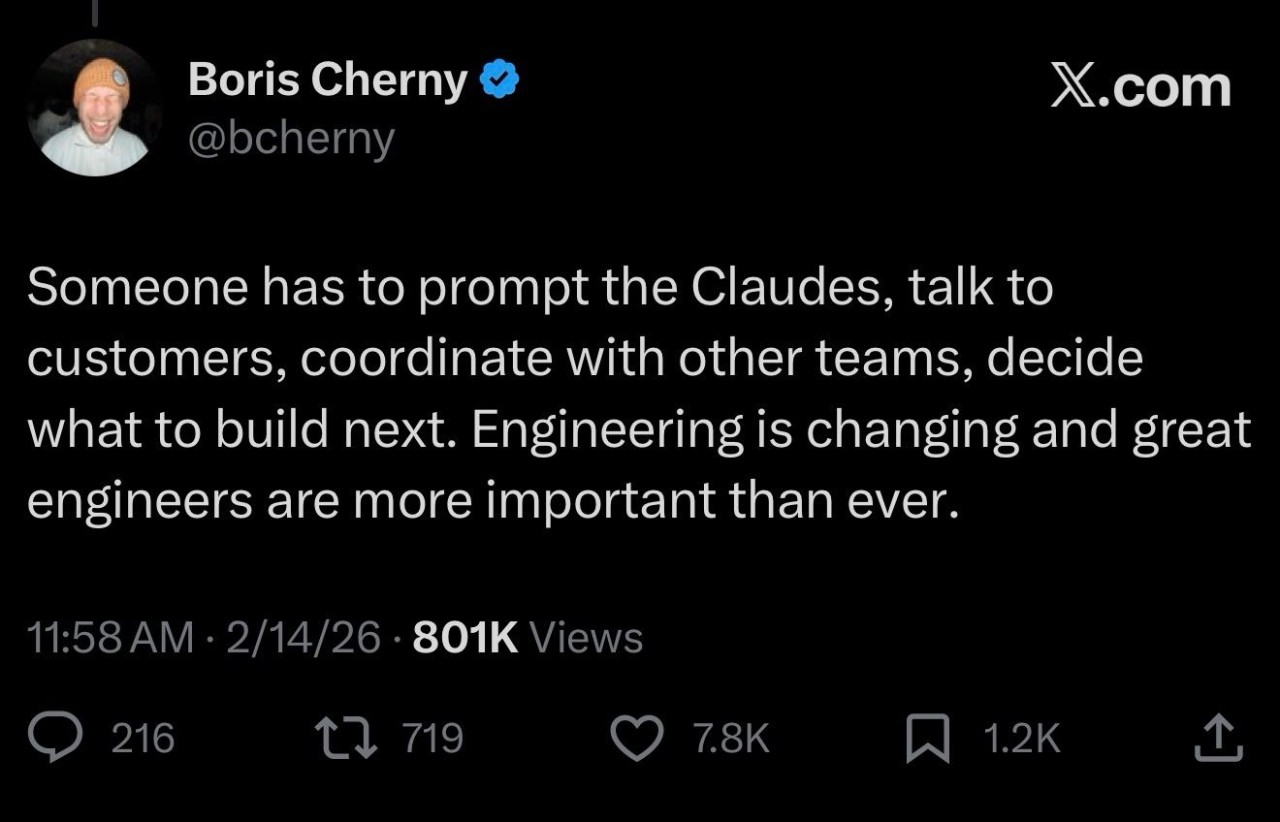
"Someone has to prompt the Claudes, talk to customers, coordinate with other teams, decide what to build next. Engineering is changing and great engineers are more important than ever."
He's right. Engineering is changing.
But here's what Boris didn't say — and what every Product Manager needs to understand:
Someone also has to decide WHAT to prompt, WHAT to build, and WHY.
That someone is a Product Manager.
And the data proves this role is becoming more valuable, not less.
The Numbers Tell a Story
February 12, 2026: Anthropic closes a $30 billion Series G funding round at a $380 billion post-money valuation.
That's the second-largest private funding round in tech history. (OpenAI raised $40B+ last year, but that's it.)
Led by D.E. Shaw Ventures, Dragoneer, and Founders Fund, this round signals something bigger than just investor hype.
Look at the revenue trajectory:
- December 2024: $1 billion ARR
- July 2025: $4 billion ARR
- December 2025: $9 billion ARR
- February 2026: $14 billion ARR
That's 14x growth in 14 months.
Anthropic has sustained 10x annual growth for three consecutive years. That's not a product-market fit signal. That's a fundamental market shift.
Where the Money's Coming From
Here's the breakdown that matters:
Claude Code revenue: $2.5 billion annualized (quadrupled since January 2026)
80% of revenue comes from enterprises (not hobbyists or side projects — real companies at scale)
Business subscriptions quadrupled in just the first two months of 2026
Projected 2028 revenue: $70 billion (with $17 billion in cash flow)
Anthropic isn't growing because developers are building weekend projects faster.
It's growing because product teams at enterprises are fundamentally restructuring how they ship.
What This Actually Means for PMs
I've been a PM for 7 years. Payments at Visa. Fintech at Careem (Uber's Middle East arm). Products serving 50M+ customers.
And I can tell you: the PM role is changing faster right now than it has in the past decade.
Here's what I'm seeing in 2026:
- Engineering teams are shipping features 3x faster than they were 18 months ago
- PMs are writing PRDs in 45 minutes instead of 6 hours
- Product orgs are running parallel experiments that used to take quarters to sequence
But here's the critical part everyone misses:
Someone still has to:
- Frame the problem
- Define success criteria
- Coordinate cross-functional teams (engineering, design, QA, legal, marketing)
- Make strategic trade-offs
- Decide what to build next
That's the PM role.
And it's more valuable than ever.
But only if you're an AI-native PM.
The Difference Between Chat Tools and Work Tools
Most PMs I talk to are using AI wrong.
They're using it like Google:
- Open ChatGPT
- Copy-paste context from a doc
- Get a response
- Close the tab
- Start over tomorrow
This is fine for brainstorming. It's fine for one-off questions.
But it's not how you 10x your output.
AI-native PMs use Claude Code like a work tool.
Here's the difference:
Chat Tool Workflow (ChatGPT):
- Open chat
- Type: "Help me write a PRD"
- Get generic template
- Manually add all your context
- Lose conversation history next week
- Start over
Work Tool Workflow (Claude Code):
- Open terminal in your project folder
- Type:
/prd checkout-flow - Claude reads your strategy docs, past PRDs, user research automatically
- Runs Socratic questioning: "What problem? Who's the user? What's the success metric?"
- Generates PRD with your company's context baked in
- Runs multi-perspective review (engineer, VP, UX, QA)
- Saves everything in your project (persistent memory)
First workflow: 6 hours.
Second workflow: 45 minutes.
That's why enterprises are paying billions for Claude Code.
What AI-Native PMs Do Differently
I've been teaching PMs to use Claude Code for the past year. Here's what the best ones do:
1. They Load Context Once
AI-native PMs use CLAUDE.md files (persistent memory). They document their product strategy, team structure, success metrics, and constraints once. Claude remembers it forever.
No more re-explaining your roadmap every Monday.
2. They Build Custom Workflows
AI-native PMs don't just "use Claude." They build tools with Claude.
/prd→ Runs full Socratic questioning workflow/standup→ Pulls Jira/Linear tasks and drafts daily update/review→ Runs multi-perspective review (engineer, design, QA, legal)/rollout→ Generates go-to-market checklist
These aren't built-in features. They're custom commands you build yourself in 20 minutes.
3. They Connect Claude to Their PM Tools
This is the game-changer.
AI-native PMs connect Claude to:
- Jira/Linear (auto-pull tasks, update tickets)
- Slack (post updates, summarize threads)
- Notion/Confluence (read docs, update pages)
- Figma (pull designs, generate mockups)
Example: One PM I know runs /standup every morning. Claude pulls her Linear tasks, drafts her update, and posts it to Slack. Saves 30 minutes a day.
Another PM built a /legal-check command. Claude reads the PRD, flags potential compliance issues (GDPR, PCI-DSS, accessibility), and suggests mitigations. Catches problems before engineering starts.
That's not "using AI to brainstorm."
That's rebuilding your workflow.
The PM Landscape Is Splitting in Two
Here's my prediction:
By 2027, there will be two types of PMs:
- AI-native PMs who treat Claude like a work tool (connected to files, custom workflows, integrations)
- Everyone else who still copy-pastes into ChatGPT
The first group will ship 3x faster, write better specs, and coordinate teams more effectively.
The second group will wonder why they're getting passed over for promotions.
Boris Cherny's viral post validates this: "Someone has to prompt the Claudes, coordinate teams, decide what to build next."
That someone is an AI-native PM.
How to Become AI-Native
I spent 6 months figuring out Claude Code the hard way.
I built workflows, broke things, read docs, tested integrations, and learned what actually works for PMs (not just engineers).
Then I turned it into a course.
It's called The AI-Native PM.
Here's what you'll learn:
Module 0: Claude Code Basics (Free, 20 min)
- Install Claude Code
- Learn the 5 terminal commands you actually need
- Run your first AI-powered conversation
Module 1: PRD Generator (Free, 1 hour)
- Socratic questioning workflow
- Multi-perspective review (engineer, VP, UX, QA)
- Build your own
/prdcommand
Module 2: Image Generator (Free, 1 hour)
- Generate mockups without Figma
- Create visual specs in minutes
Module 3: MCP Integrations (Free)
- Connect Claude to Jira, Linear, Slack, Notion
- Build custom integrations
- Automate cross-functional workflows
The Question Isn't "Should I Learn This?"
The question is: Are you adapting to the shift?
Anthropic went from $1B to $14B in 14 months.
Claude Code hit $2.5B in revenue.
Enterprises are rebuilding workflows.
PMs who can prompt, coordinate, and decide what to build are more valuable than ever.
But only if they're AI-native.
Start here (free, 20 min): theainativepm.com
What part of your PM workflow takes the longest? I'd love to hear — reach out on LinkedIn.
Sources:
Product Manager at Careem (Uber), building payments for 50M+ customers. Previously at Visa and RAENA. I write about practical AI workflows for product managers.
More about me →